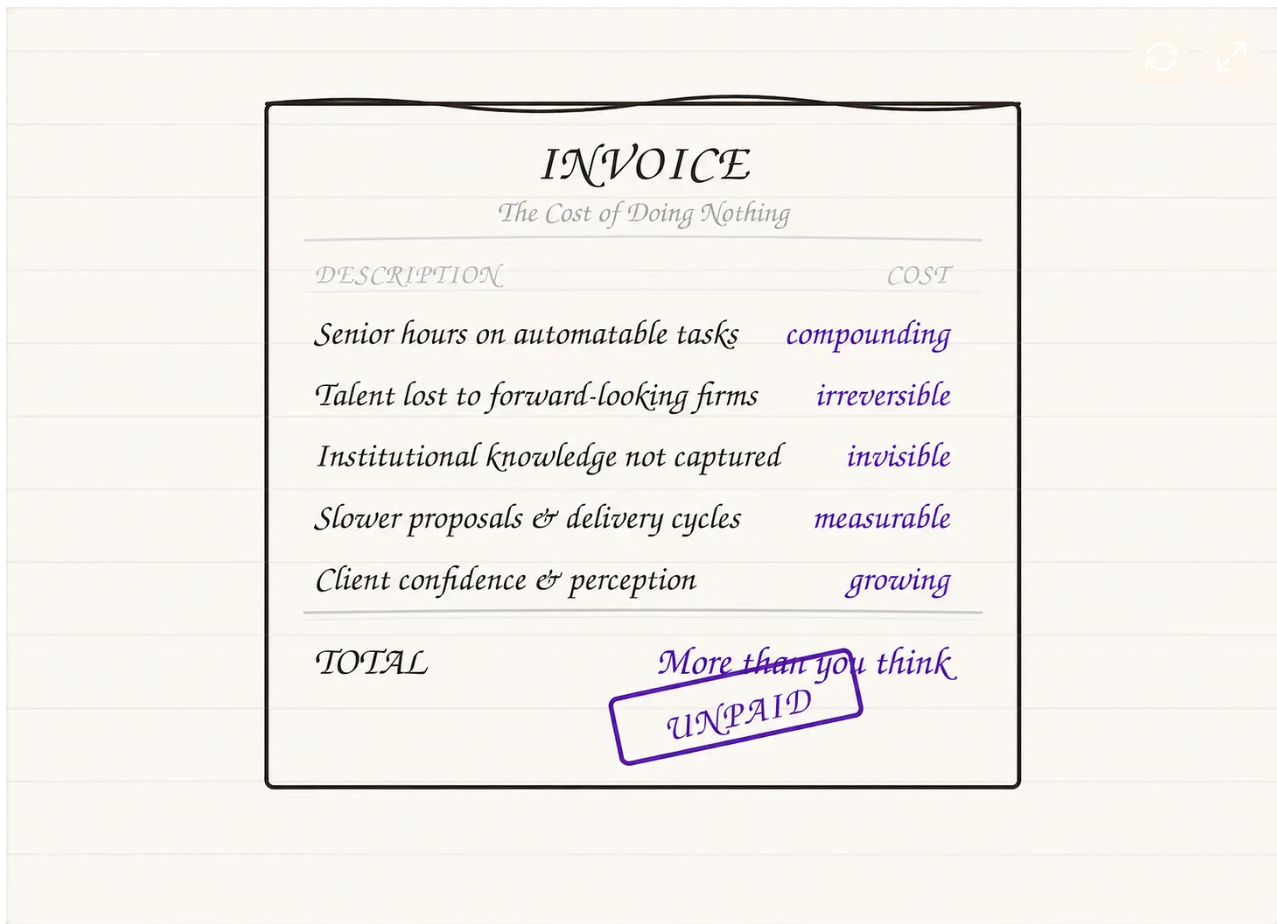
I was in a leadership meeting when the CEO asked a question: “What is the cost of doing nothing with AI?”
We spend enormous energy debating AI: the risks, the readiness, the right moment to act. Those are fair conversations. But the question above moved the discussion from whether to act toward a harder question. What are we losing by standing still?
In AEC firms, the instinct is often to wait. Wait for the technology to mature. Wait to see how competitors move. Wait until there’s a clear ROI. That caution feels responsible. In many cases, it has been.
But, in the new world of AI, waiting has a price tag. We rarely invoice ourselves for it.
The Invisible Invoice
The cost of inaction accumulates quietly. In the hours your senior staff spend on tasks that could be automated and are not intellectually stimulating. In the proposals that take longer than they should. In the institutional knowledge that walks out the door because it was never captured. And in the talent who leave for firms that feel like the future.
Consider what’s at stake:
- Productivity gaps that widen as AI-enabled competitors deliver faster and with higher quality
- Talent expectations — younger engineers increasingly choose employers based on the tools they’ll work with
- Institutional knowledge — every year without AI-assisted capture is another year of expertise living only in your staff’s heads
- Client perception — sophisticated clients are starting to ask what tools their partners use
“Inaction is not a neutral position. It is a choice. Like every choice, it has consequences.”
The Compounding Effect
The cost of doing nothing compounds. A firm that starts building AI fluency today will be meaningfully ahead in 18 months. Not because they deployed some breakthrough system, but because their people will have learned how to work alongside AI. That organizational muscle takes time to develop. There are no shortcuts to it.
Meanwhile, the firm that waits will face a steeper climb. Not just technically, but culturally. Change fatigue is real. The longer AI feels like something happening elsewhere, the harder the internal pivot becomes.
This Isn’t a Call to Rush
Smart adoption is still smart. Deploying tools without strategy, training, or governance creates its own costs: wasted investment, staff frustration, and liability exposure in a licensed profession. Engineering firms are right to be deliberate.
The question worth sitting with isn’t “Should we move fast?” It’s “Are we moving at all?”
There’s a meaningful difference between a firm that is learning, piloting, and building toward AI fluency, and one that is simply hoping for the AI moment to pass.
The real question isn’t whether AI is ready for your firm. It’s whether your firm is building the readiness to meet it. Before the cost of not doing so becomes impossible to ignore.