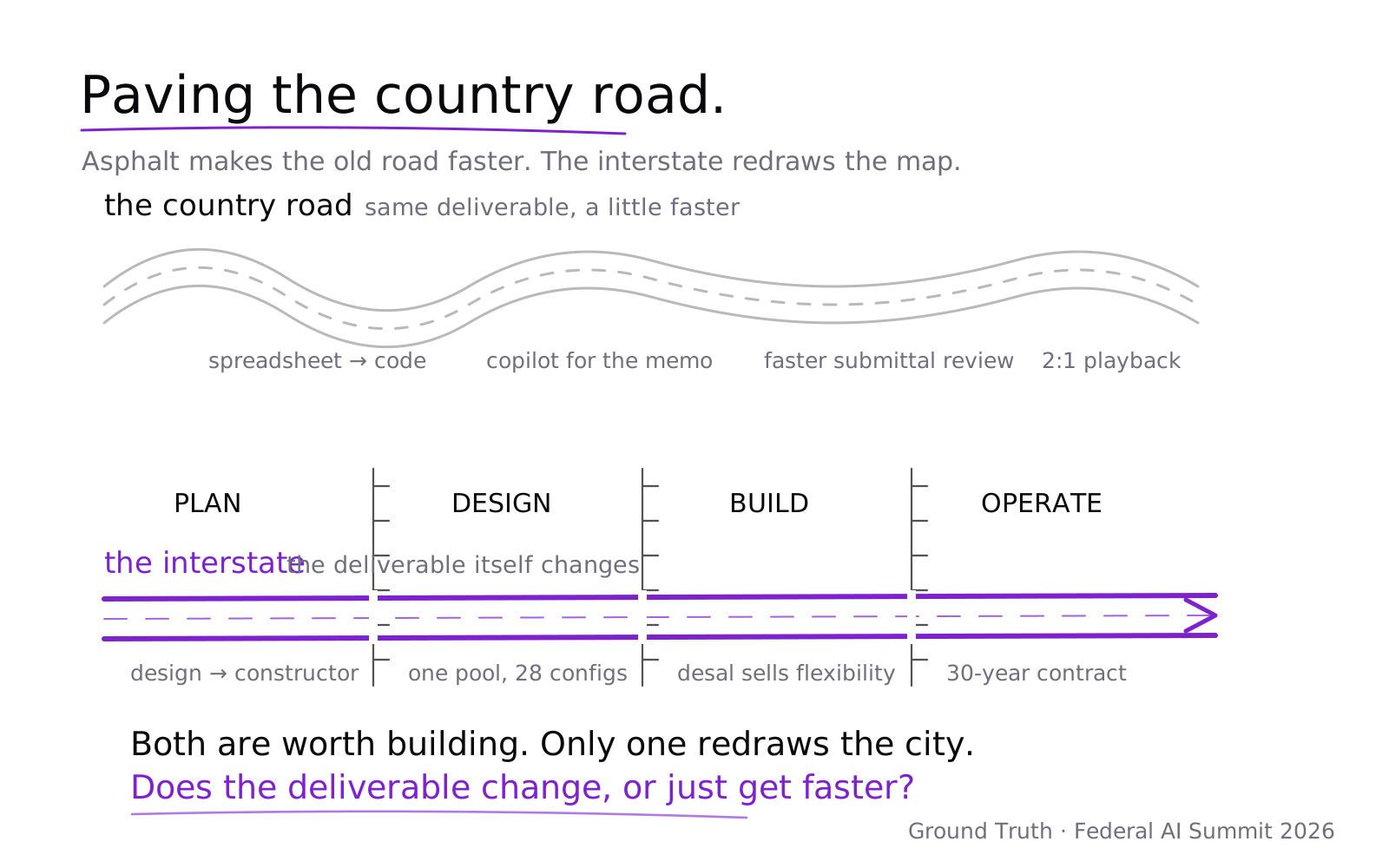
CTO of GFT, Greg Thompson, offered an analogy at the Federal AI Summit last week.
Asphalt, he said, is a technology. Before asphalt you had dirt roads and horse-drawn carriages. Put asphalt down and the country road gets faster and easier on the wheels. That is a real improvement, and it is what most of the industry is doing with AI right now: taking the existing process and making it a little quicker and a little smoother.
What if the question was about the fastest way to get from point A to point B? What if you could go coast to coast without stopping? That is the interstate. And once the interstate existed, people redesigned cities around it.
We don't yet know what the "interstate" is for this industry is with AI in play (I am reserving my thoughts on this for later). I want to say that the Federal AI Summit supplied some answers.
Why the country road is so tempting
Adam Sadilek, CEO of AIM Intelligent Machines, whose team came from autonomous vehicles, described the moment he decided to build for construction. Take grayscale footage of a job site today and put it beside footage from the 1960s. It is hard to tell which is which. Very little about how we move earth, pour concrete, and coordinate trades has changed in many decades. That is the baseline AI is being applied to, and it explains why paving feels so productive. There is a lot of road.
David Harwood, SVP of Business Transformation at Terracon, gave the honest view of where firms are. His company used AI to write code that replaced its engineering spreadsheets: build a soil model, run every calculation, with plans to feed a reporting tool. It works. And, as he put it, they have not fundamentally changed what they do to deliver a report. Earlier in the same session he had drawn the distinction sharply. Almost all AI inside firms today is personal productivity: someone using a copilot to speed up a localized task. The organizational level is a different exercise. It means breaking the work down and starting over, ideally with people who have no attachment to the current process.
Personal productivity is asphalt. It is worth doing, it shows up in the numbers, and it leaves the city exactly where it was.
What the interstate looks like
Four examples. None about any specific AI tool.
- 01
The contract asked a different question.
The Paris Olympic Aquatics Center was contracted to a team responsible for designing that would function for thirty years, well past the Olympics. Faced with three decades of heating and treating water, the team designed the smallest pool that could work, reconfigurable into twenty-eight arrangements. A conventional procurement would have bought several larger pools: cheaper to build, and unaffordable to run. Same city, same Olympics, radically different asset.
- 02
A water asset that is also an energy asset.
Meagan Mauter, who directs Stanford's Water & Energy Efficiency for the Environment Lab, described helping Santa Barbara treat a desalination plant as an energy asset as well as a water asset. Run flexibly around grid conditions, it can save upward of twenty percent of its power cost. The same city built a plant in the late 1980s that opened at seventy-five million dollars, ran for three months, and sat idle for twenty years. Static planning, static construction, static operation. The interstate version plans dynamically, builds in increments, and operates against real conditions.
- 03
An acquisition cycle disappears.
Air Force Civil Engineering Center (AFCEC) leader described using AI at the front of design rather than the back, targeting a design cycle measured in weeks rather than eighteen months. The interesting part is what happens next. The machine-assisted design goes to the constructor to finish, and if the owner approves it, they build. An entire acquisition cycle disappears from the program. That is a redesign of the road, and it happens to also be faster.
- 04
A modern factory that happens to be outdoors.
Sadilek described what his customers actually asked for, which was never autonomous machines. What they wanted was the entire earthmoving cycle running without people in the danger zone. His company now operates zero-entry sites, with no human on the ground at all. The parts come in, the work comes out, and the observability is total.
The common thread
Each of those examples crosses a seam the industry has spent a century keeping closed. Design to operations. Water to energy. Owner to constructor. Planning to execution. Martin Fischer, who directs Stanford’s Center for Integrated Facility Engineering, made the point in his opening remarks and returned to it all day: automation inside one silo is good, and it rarely produces systemic impact. Impactful automation connects data across several silos at once.
Matt Gough, Director at Cogital who spent years inside the UK’s construction reform effort, described a survey of fifty industry leaders this year. Every one of them was bullish. Budgets up, pilots turning into programs, returns arriving. And every one of them was staying in their lane, focused on the scope they already owned. His observation was that the cost of knowledge is heading toward the cost of the electricity that runs the machines, and that an industry which stays contract-bound and adversarial will use that to do the same things it does now, a little faster. The UK’s own answer, he said, has been to stop buying projects one at a time and start buying committed pipelines that can be delivered industrially.
Steve Blank closed the day with a small story that belongs here. This year, for the first time, every team in his Hacking for Defense class arrived on day one with a finished product. AI made it easy. And because they had a product, they skipped the problem. He no longer lets students say “minimum viable product.” The phrase is now “initial, untested product,” because words shape what people believe they are holding.
The country road is the finished product on day one. The interstate is the problem you find when you put the product down.
The question for Monday
If you run a firm, an agency program, or a project, here is a test you need to apply.
Look at the last three AI initiatives you approved. For each one, ask whether the deliverable at the end is the same deliverable as before, produced faster. If it is, you have paved the country road, and you should keep paving. Then find the one initiative on your list where the deliverable itself would change: a design that goes straight to a constructor, a plant that sells flexibility as well as water, a contract that carries the operator’s incentives back into the drawings.
Finding your interstate.
It is almost certainly the most transformative thing on the list (not the most expensive) to try and the hardest to get approved (because it may not exist quite yet), and it is where the next decade of this industry will be decided.
Pooja Jain is CEO and Founder of Innov8 Consulting, Adjunct Faculty at Stanford, and co-chair of the Federal AI Summit, a collaboration between SAME and Stanford CIFE.